

Specchio (Italy)
The Story of Specchio
Origins and geography
Specchio is a hamlet in the municipality of Solignano (PR), located on a hill about 566 metres above sea level, in the middle of the Ceno Valley. Today, it has very few inhabitants.
The village is built around the hill known as Monte Spinola (formerly “Monte Specla / Specla”), from which the name of the village probably derives: from “Specla/Spinola” to Specchio.
A strategic role in the Middle Ages
As early as 673, the hill of Monte Specla/Spinola was at the centre of a dispute over the demarcation of civil boundaries between the jurisdictions of Parma and Piacenza, demonstrating the strategic importance of the place.
In the following centuries, a castle was built on the hill. We do not know the exact date of construction, but a drawing preserved in the State Archives of Parma attests to its existence around 1600.
The castle allowed control over a large territory: the surrounding valleys, the hills and the valley of the Ceno stream. From here, it was possible to observe any movements of troops, invaders or marauders. Specchio thus became an important landmark for the area and also for pilgrims travelling to Rome who passed through these valleys.
Changes in dominion and lordships
In 1132, the municipality of Piacenza, with the approval of the competent bishop, purchased the lands and castle of Specchio from two brothers, Attone and Alberico da Fabbrica, consolidating its dominion over the territory.
With the expansion of the Duchy of Milan under Gian Galeazzo Visconti, between the end of the 14th century and the beginning of the 15th, Specchio was assigned as a fief to the noble Pallavicino family, loyal allies of the duke.
In 1422, the investiture passed to Manfredo Pallavicino; a few years later, however, in 1428, due to a conspiracy against the duke, Manfredo was defeated, imprisoned and killed. With his demise, his rule over Specchio also came to an end.
Decline of the historic village
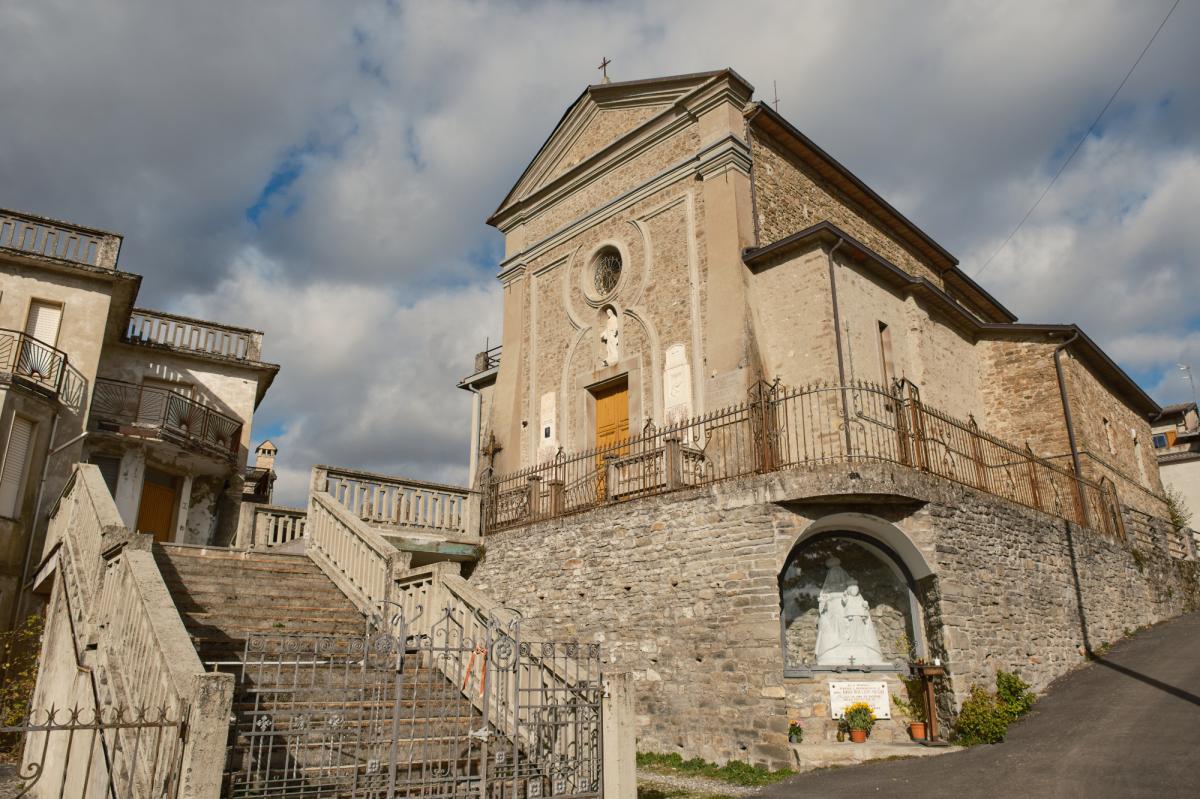
Until relatively recently, Specchio retained its charming old village: stone houses, the rectory, the church, the bell tower, a tavern and an elegant Risorgimento-era palace with a park and garden.
However, the demolition of the old rectory and the construction of modern buildings (parish house, former school and other structures) have compromised much of the historical and landscape heritage.
Today, only a few old buildings and traces of the past remain of its former splendour: the village has lost much of the historical identity that once made it a significant centre in the middle Val Ceno.
Ecclesiastical conflicts and territorial affiliation
The church of Specchio and its possessions were also often the subject of controversy between the curia of Piacenza and that of Parma. As early as 854, there was a dispute over the division of tithes due for the lands of Specchio, involving the archpriests of Varsi (Piacenza) and Fornovo (Parma), as well as a local administrator. On that occasion, the count and bishop of Piacenza established that Monte Spinola – and therefore the area of Specchio – fell under the jurisdiction of the Curia of Piacenza.
Only in more recent times did the parish of Specchio pass from the diocese of Piacenza to that of Parma, marking the latest change in a long history of territorial and religious disputes.
Sources:




Progetto PNRR
[M1.C3 – INVEST. 2.2 “Architettura rurale”]
NextGenerationEU - Codice CUP: E88C22000580004